
If you plan to use a campervan during the summer months, keeping the interior of your vehicle cool will be one of your top priorities. On a hot day, parking in the shade and opening the windows may not be enough to keep your van sufficiently comfortable. If you want to install an air conditioner for van use, there are many models and designs to choose from.
In fact, the global market for RV and campervan cooling systems reached an estimated USD 1.5 billion in 2024, and it’s projected to grow strongly as more people embrace the van life lifestyle.
And if you’re not sure where to look, don’t stress…Van Builder HQ is here to help!
In today’s guide to the best campervan air conditioner units and a full buying framework for the van life air conditioner searcher, we’re going to take a closer look at the top models and provide you with all the information you need to make the right decision for your build.
Let’s get started!

Top Pick (Updated): Velit 2000R Series
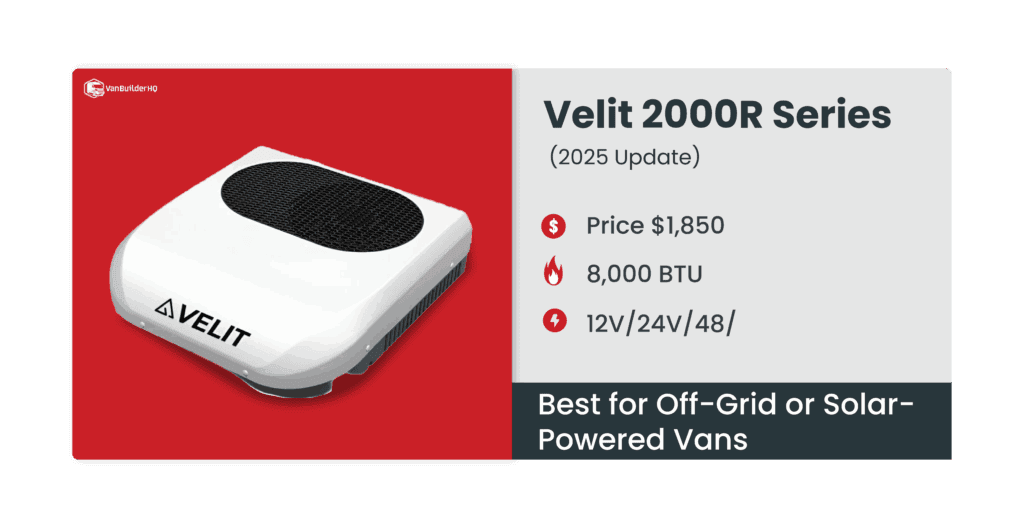
If you’re looking for excellent cooling performance and versatility at a more accessible price point, the Velit 2000R air conditioner is now our top recommendation. This unit offers a great balance of performance, cost and flexibility for off‑grid setups.
It is one of the strongest 12V air conditioner options for campervan use thanks to its low current draw and multiple voltage choices. According to the manufacturer, the compressor can draw as low as 20 amps at 12 V.
Why we love it:
- Higher cooling capacity (up to 8,000 BTU) which gives strong output when you’re parked in full sun or in hotter climates
- Multiple voltage options for different battery setups (12V, 24V and 48V) meaning you can scale up your battery bank or future‑proof your build
- Lower price compared to many rooftop units of similar specification
- A compact Velit Mini version is also available, ideal for maximizing rooftop space and accommodating solar panels.
⚠️ One caveat: Velit’s service network is not as established as some long‑standing brands. Parts may not be as easy to source everywhere, so consider this a high‑value unit with slightly more risk if you travel in remote areas.
Specs and hard facts worth noting:
Because it runs directly from DC (12V/24V/48V) it removes the need for a large inverter, which is beneficial for off‑grid systems powered by battery or solar.
The Velit 2000R fits standard 14″ × 14″ roof cutouts and has a low profile (only about 7″ of clearance) making it suitable for vans where roof height or panel clearance might be tight.
Still a Great Option: Dometic RTX 2000
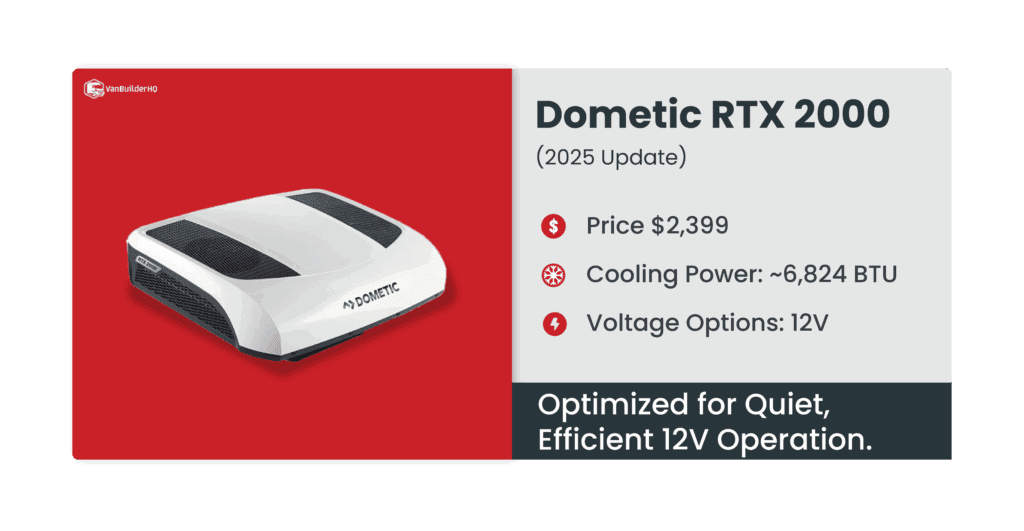
If your priority is a well‑known brand with proven performance and quiet operation, the Dometic RTX 2000 is a strong contender. This 12V rooftop air conditioner for campervans has been field‑tested in real‑world van‑life setups and is praised for its efficient design and mobility‑ready features.
Why we like it:
- Offers up to ~6,824 BTU cooling capacity…well‑suited for midsize vans with decent insulation.
- Runs in Eco mode drawing around 19 Amps at 12V…making it one of the more efficient 12V air conditioners for van use.
- Compact rooftop design: leaves more roof real‑estate free for solar panels or racks.
- Brand reliability: Dometic has a large service network and established support in the RV/van sector, helpful for repairs or parts down the line.
⚠️ One caveat: The cooling capacity is slightly lower than some newer 12V models (for example, the 8,000 BTU class). So if you’re in very hot climates or using a van with poor insulation, you may need to give it extra help (e.g., pre‑cooling, fans).
Specs and real‑world notes worth knowing:
- The model is rated at ~6,824 BTU and uses a variable‑speed inverter compressor.
- According to user tests, the RTX 2000 can run for ~9 hours or more overnight on a properly sized lithium battery bank, even in summer temperatures with moderate loads.
- Fitment note: The internal roof opening required may differ from standard 14″ x 14″ fan cutouts…some builders report needing ~14.5″ x 15.5″.
- Noise levels: Field tests show it runs noticeably quieter (≈30% quieter) than older 110V rooftop units…a big plus for van builds where sound matters.
How to Choose the Right 12V Campervan Air Conditioner
What Makes an AC Efficient Off-Grid?
If you’re running off-grid power, 12V air conditioners for campervans like the Velit or Dometic RTX are your best bet. They connect directly to your battery bank, avoiding power losses from inverters. The Velit 48V model is especially efficient if you’re running a 48V air conditioner for campervan setups such as the EcoFlow Power Kit.
How Much Cooling Power Do You Actually Need?
More BTUs mean more cooling power. The Velit 2000R offers up to 8,000 BTU, while the Dometic RTX 2000 tops out at 6,824 BTU. For midsize to large vans, 7,000–8,000 BTU is a good range to aim for. When deciding on BTU for campervan air conditioner, consider insulation, climate, and how much solar or battery capacity your system can handle.
Is It Quiet Enough for Sleep?
Both Velit and Dometic units run relatively quietly at low speeds. If nighttime comfort is important, look for a quiet campervan air conditioner and consider adding insulation or using Eco mode to reduce overall campervan AC noise level.
How Long Will It Last (and Can You Get Parts)?
Dometic air conditioners stand out for proven reliability and an established service network with easily sourced replacement parts. Velit is newer to the market, and while its early performance has been impressive, its long-term durability is still being proven.
Will It Fit with Solar and Roof Gear?
Velit offers multiple unit sizes, including a compact rooftop AC for van such as the Velit Mini (26.4″ x 26″ x 6.5″). It’s a great fit if you want to flank it with slim solar panels. Dometic, on the other hand, currently offers only one model size.
Pro Tip: Pair a Velit Mini with a Unaka Gear roof rack and two Rich Solar 200W slim panels (each 15.7″ wide) to fully maximize your rooftop space.
How Easy Is It to Install?
Both units require roof cutting and sealing, so proper planning is critical. Dometic RTX 2000 installation is well supported with clear documentation. Velit’s installation is straightforward too, though its manuals and resources may be slightly less detailed.
Types of Campervan Air Conditioners (Non‑Ducted, Rooftop, Ducted)
Non‑Ducted (Most Common for Vans)
When you pick a non‑ducted campervan air conditioner, you’re choosing what most van‑builders go with: a single rooftop unit that blows cool air directly into the living space. It’s simple, quicker to install, and lower cost.
According to recent RV‑build guides, non‑ducted systems are easier to set up without hidden ducts and because your van is smaller, airflow from one point often does the job.
1. Great for open‑plan van layouts where one air outlet will reach everything.
2. Less invasive: no long roof‑duct runs, fewer vents through the ceiling.
3. Trade‑off: you may get hot or cold spots further from the main vent, and noise tends to be more pronounced since the unit is right above your living area.
Rooftop Units (12V Options for Vans)

If you’re building for full mobility or off‑grid power, the rooftop campervan air conditioner is one of the best fits. A 12V rooftop AC for campervan setups means the unit taps straight into your battery/solar system, avoiding large inverters. These units are made for vans with limited space and power budgets.
- Check clearance: ensure your roof profile fits the unit and leaves room for solar panels or roof racks.
- Power draw matters: make sure your battery/solar system can support continuous draw under load (especially midsummer afternoons).
- Placement counts: mounting the unit where it has good airflow and drainage will reduce risk of leaks or condensation.
Ducted (Space / Complexity Trade‑offs)
Choosing a ducted campervan air conditioner means you’re going for something more like residential HVAC. Cool air runs through hidden ceiling ducts to multiple vents. It offers even distribution and quieter operation, but also higher cost, weight and installation complexity.
- Ideal for larger vans or multi‑room builds where you want consistent temperature throughout.
- For many van builds, it may be overkill, unless comfort zones and full‑time living are your priority.
- Expect more parts: ductwork, vents, possibly multiple zones, which raise cost and maintenance.
Powering Your Campervan AC Off-Grid (12V/48V, Batteries, Solar)
Battery Bank Basics (Start Around 300Ah, But Depends on Runtime)
If you’re thinking of running a battery powered air conditioner for your van, just know that 300Ah is the bare minimum for short overnight use and only with a 12V unit running in Eco mode. Most real-world vanlifers who use their AC regularly go with 400–600Ah or more. That gives enough headroom for multiple hours of runtime, especially if you’re in warm climates.
Tips:
- Go lithium. They give you more usable capacity than AGM batteries.
- Check your unit’s hourly amp draw in Eco and full power modes.
- Build your system around your actual cooling hours, not just the unit size.
Example: The Dometic RTX 2000 in Eco mode draws about 19A/hr. That’s 152Ah for 8 hours of overnight cooling.
Solar Sizing (600–1,000W Is a Safe Range)
Most builders aiming for an off-grid air conditioner for van life pair their battery bank with 600–1,000 watts of solar, depending on roof space and usage. If you’re planning to use your AC daily, lean toward the higher end.
Things to consider:
- Panels don’t always produce rated power, especially on cloudy days or when dirty.
- MPPT controllers and good wire sizing matter more than people think.
- If you’re using a 48V system, solar efficiency improves but parts are more niche.
If you’re in hotter states or Europe’s southern regions, 1000W+ is realistic for daily use and recharge cycles.
When Shore Power Just Makes More Sense
If your campervan air conditioner power draw is above what your system can reliably handle (like with 120V units) shore power is the more practical option. Running something like a Dometic Penguin II or Coleman Mach 8 on 120V can spike over 3,000W at startup.
When to plug in:
- If you’re using a traditional 120V RV AC
- If you have limited solar or battery capacity
- If you park at powered sites often
Pro tip: If you still want the flexibility to go off-grid sometimes, consider a hybrid setup with a small 12V AC for nights and a 120V unit for when you’re plugged in.
Maintenance Tips for Campervan ACs
Luckily, most 12V rooftop units are pretty low-maintenance but that doesn’t mean set-it-and-forget-it. Just a few small tasks every few months can prevent bigger problems like icing, weak cooling, or higher power draw.
Here’s what you should do:
- Inspect for leaks around the mounting seal at least once a year
Water damage around the AC frame can go unnoticed until it becomes a bigger issue. Do a simple visual check and run a hose test if needed.
- Clean condenser coils with foaming spray annually
Dirty coils reduce cooling efficiency. A can of coil cleaner and a soft brush once a year will go a long way. If airflow feels weak, this is usually the first place to check.
- Check and clean air intake filters every 1–2 months to prevent icing
A clogged filter strains the system and can cause ice to form around the evaporator. Regular AC filter cleaning keeps things running smooth and keeps your air cleaner too.
Tips to Keep Your Van Cool (With or Without AC)
Even the best air conditioner has its limits, especially on hot days or when you’re trying to conserve power. Knowing how to keep a van cool without AC is just as important. Whether you’re boondocking, sleeping off-grid, or just trying to reduce AC use, these small tricks can make a big difference.
Here’s what works:
- Park in the shade
Obvious, but underrated. A few hours of direct sun on your roof can make the difference between bearable and brutal.
- Use a roof vent fan
A roof vent fan like the Maxxair or Fan-Tastic helps pull hot air out and brings in cooler air once the sun drops.
- Install insulated window shades
Factory curtains don’t cut it. Good insulated window shades (like Reflectix or thermal covers) block radiant heat and help retain cool air inside.
- Add insulation to your van
The better your walls, ceiling, and floor are insulated, the longer it takes for heat to build up. Don’t skip insulation, it helps year-round.
- Open doors/windows at night, close them early in the morning
Let in the cool air overnight, then trap it by sealing the van before the sun hits.
- Use light-colored window covers and roof surfaces
Reflects heat rather than absorbing it. Small change, big difference.
FAQs
How quiet are campervan air conditioners?
Most fall between 35 and 75 decibels. Dometic and Velit units run quieter at lower speeds, especially in eco mode.
What types of AC units are best for campervans?
12V rooftop ACs like Velit and Dometic are the gold standard for off-grid use. Avoid 120V units unless you always have shore power access.
Should you run a dehumidifier with an air conditioner?
No. AC units already remove moisture from the air as they cool. Running both wastes energy unnecessarily.
What’s the best portable camper AC?
The EcoFlow Wave 2 is a solid portable option with a 4,000 BTU output and optional battery pack for off-grid use.
Can solar panels power a campervan AC?
Yes, but you’ll need a sizable solar array (600W–1,000W) and a large battery bank to run it consistently. For example, a 12,000 BTU unit may draw ~900W/hour.
Final Thoughts
Whether you go with the Dometic RTX 2000 or the Velit 2000R, both are solid picks for a 12V campervan air conditioner. Your decision mostly comes down to what matters more to you.
- Go with Velit if you want more BTU output, lower cost, and flexible sizing (especially if you’re planning a 48V system).
- Go with Dometic if you value brand reliability, easier access to parts, and wider support.
Either way, take time to plan your roof layout. Solar panels, vents, and your AC unit all compete for space up there. And no matter which model you choose, good insulation and airflow will make a bigger difference than specs alone.
